
What we do
Crawl spaces in Nashville are some of the most neglected square footage in any home. They sit out of sight, below the living area, and most homeowners never look down there unless something goes wrong. By the time something goes wrong, the damage is usually well advanced. Standing water, saturated soil, dripping condensation on floor joists, and visible mold on subflooring are problems we see every week in crawl spaces across Davidson, Wilson, and Sumner counties. Middle Tennessee's combination of clay-heavy soils, high seasonal humidity, and older pier-and-beam construction makes crawl space water problems nearly inevitable for homes that lack proper drainage and vapor barriers.
Nashville's soil profile is the root of most crawl space moisture issues. The region sits on a base of limestone overlaid with dense clay. Clay soil does not drain well. During spring rains or sustained wet periods, groundwater rises and has nowhere to go except laterally, into your crawl space. Homes in Hermitage, East Nashville, Inglewood, and Hendersonville sit on some of the worst-draining clay in the metro. Many of these neighborhoods were developed in the 1950s and 1960s with pier-and-beam foundations that have no waterproofing, no sump systems, and either no vapor barrier at all or a deteriorated sheet of visqueen that was laid directly on dirt decades ago and has long since torn, shifted, or decomposed.
Standing water in a crawl space is not just a nuisance. It is an active threat to your home's structural integrity and your family's health. Floor joists that stay wet for extended periods lose structural strength as the wood fibers break down. We routinely find joists in Nashville crawl spaces with moisture content above 30 percent, well past the threshold where fungal decay organisms become active. Once wood rot sets in, the damage accelerates. Bouncy or sagging floors in the living space above are often the first sign a homeowner notices. By that point, the joist damage may be significant enough to require sistering or full replacement.
Mold is the other major risk. A crawl space with standing water or relative humidity above 60 percent is a mold incubator. The combination of moisture, organic material (wood framing, paper-faced insulation, stored items), and warm air creates ideal conditions for Aspergillus, Penicillium, and Stachybotrys colonies. What makes crawl space mold particularly dangerous is the stack effect: warm air rises through the house, pulling air from the crawl space up through gaps in the subfloor, around plumbing penetrations, and through HVAC returns. Studies estimate that 40 to 50 percent of the air on your first floor originated in your crawl space. If that air is carrying mold spores, your family is breathing them whether they go near the crawl space or not.
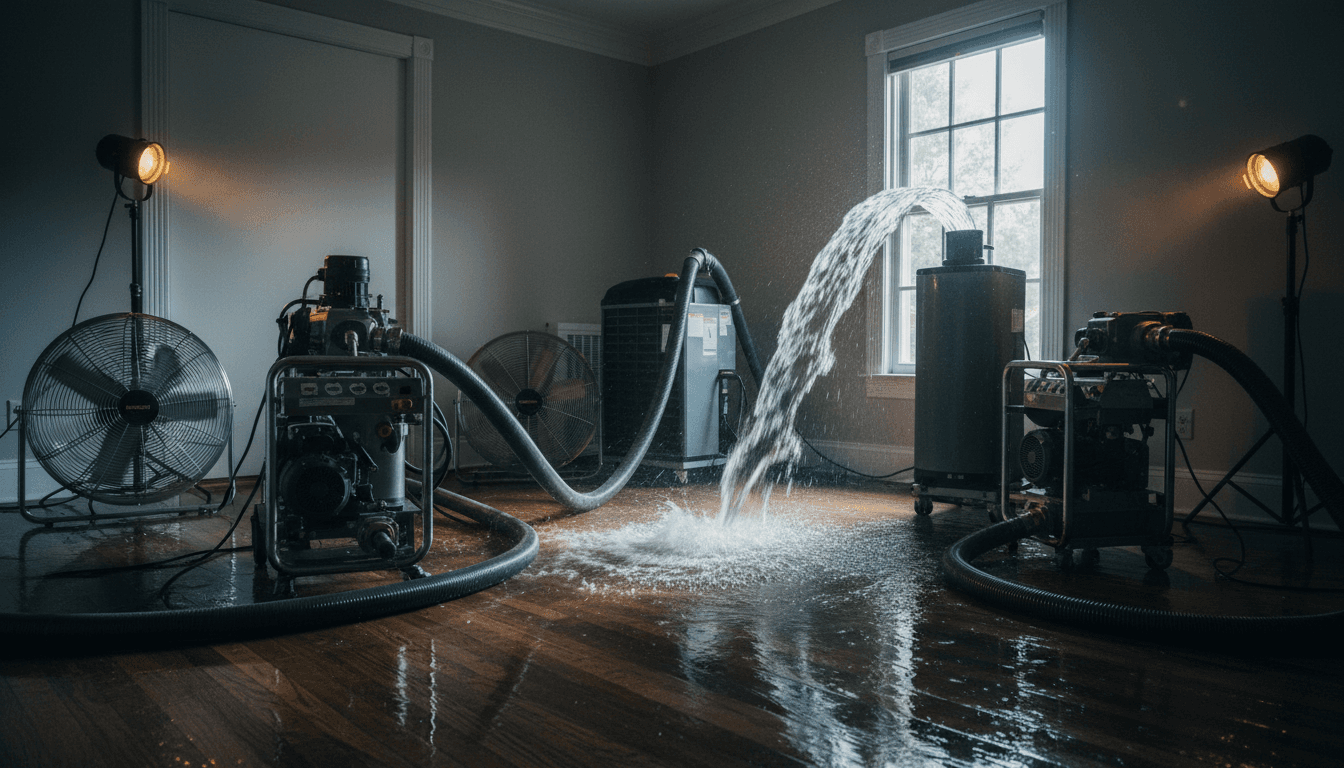
Our crawl space drying process starts with getting the water out. For active standing water, we deploy submersible pumps and truck-mounted extraction equipment to remove the bulk volume. We then assess the source. Is groundwater entering through the foundation walls or rising through the soil? Is a plumbing leak dripping from above? Is condensation forming on cold-water pipes or HVAC ducts? The answer determines the permanent fix. Pumping water out without addressing the source is a waste of your money and our time.
Once the crawl space is pumped and the source is identified, we bring in commercial dehumidifiers and air movers rated for confined spaces. Crawl space drying is slower than open-room drying because air circulation is restricted, clearance is limited, and the soil itself holds moisture that continues to evaporate into the space. We monitor moisture levels in the wood framing, the subfloor, and the ambient air daily until readings stabilize at acceptable levels. For most Nashville crawl spaces, this takes five to eight days depending on the season and the severity of the initial water event.
After drying, we address long-term moisture control. For most crawl spaces in Nashville, the right answer is full encapsulation: a heavy-duty vapor barrier (20-mil reinforced polyethylene, not the thin 6-mil sheeting sold at hardware stores) covering the entire floor and extending up the foundation walls, sealed at all seams and penetrations. A properly sized commercial-grade dehumidifier is installed to maintain relative humidity below 55 percent year-round. Drainage corrections, including interior French drains and sump pumps, are added where groundwater intrusion is recurring. We also inspect and repair any damaged floor joists, rim joists, or subflooring before sealing the space. The finished crawl space should be dry, clean, and controlled, not just patched.
If you have noticed soft or bouncy floors, musty smells rising from below, elevated humidity in your ground-floor rooms, or visible moisture under your home, call us at (931) 499-1177. We inspect crawl spaces across Nashville and the surrounding counties at no cost for the initial assessment. The longer crawl space water sits, the more it costs to fix. Joist repairs, mold remediation, and subfloor replacement all add to the bill. Catching it early and encapsulating properly saves thousands of dollars and years of compounding damage.
What to expect
- 1
Crawl space inspection
A technician enters the crawl space to assess standing water levels, identify the moisture source (groundwater, plumbing leak, or condensation), check floor joists and subfloor for rot or mold, and document conditions with photos and moisture readings. This inspection is free for Nashville-area homeowners.
- 2
Water extraction
Submersible pumps and truck-mounted equipment remove all standing water. For crawl spaces with limited clearance, we use low-profile pumps designed for tight spaces. Extraction continues until no free-standing water remains on the soil or vapor barrier surface.
- 3
Source correction
We fix the problem that let water in. Plumbing leaks are repaired or referred to a licensed plumber. Groundwater intrusion may require interior French drains, sump pump installation, or exterior grading corrections. Condensation issues are addressed with insulation and dehumidification.
- 4
Structural drying
Commercial dehumidifiers and air movers rated for confined spaces are deployed throughout the crawl space. We monitor moisture content in floor joists, rim joists, and subflooring daily. Drying typically takes 5 to 8 days depending on season and severity.
- 5
Joist and subfloor repair
Damaged floor joists are sistered or replaced. Rotted rim joists and subfloor sections are cut out and rebuilt. Any mold on structural wood is treated with antimicrobial agents before encapsulation. We do not seal over damaged framing.
- 6
Encapsulation
A 20-mil reinforced vapor barrier covers the entire crawl space floor and extends up foundation walls. All seams are taped and sealed. A commercial-grade dehumidifier is installed to maintain humidity below 55 percent year-round. The finished crawl space is clean, dry, and monitored.