
What we do
Mold does not wait. Given moisture, warmth, and an organic food source — drywall paper, wood framing, carpet backing, dust — mold colonies can establish within 24 to 48 hours of a water event. Nashville's climate accelerates this timeline. Middle Tennessee's average relative humidity runs between 70 and 85 percent from May through September, and indoor humidity in homes without adequate HVAC or dehumidification can easily exceed the 60 percent threshold where mold thrives. Every water damage event in Nashville — a burst pipe in Bellevue, a roof leak in Donelson, a basement flood in Hermitage — carries mold risk as a secondary consequence if drying is delayed or incomplete.
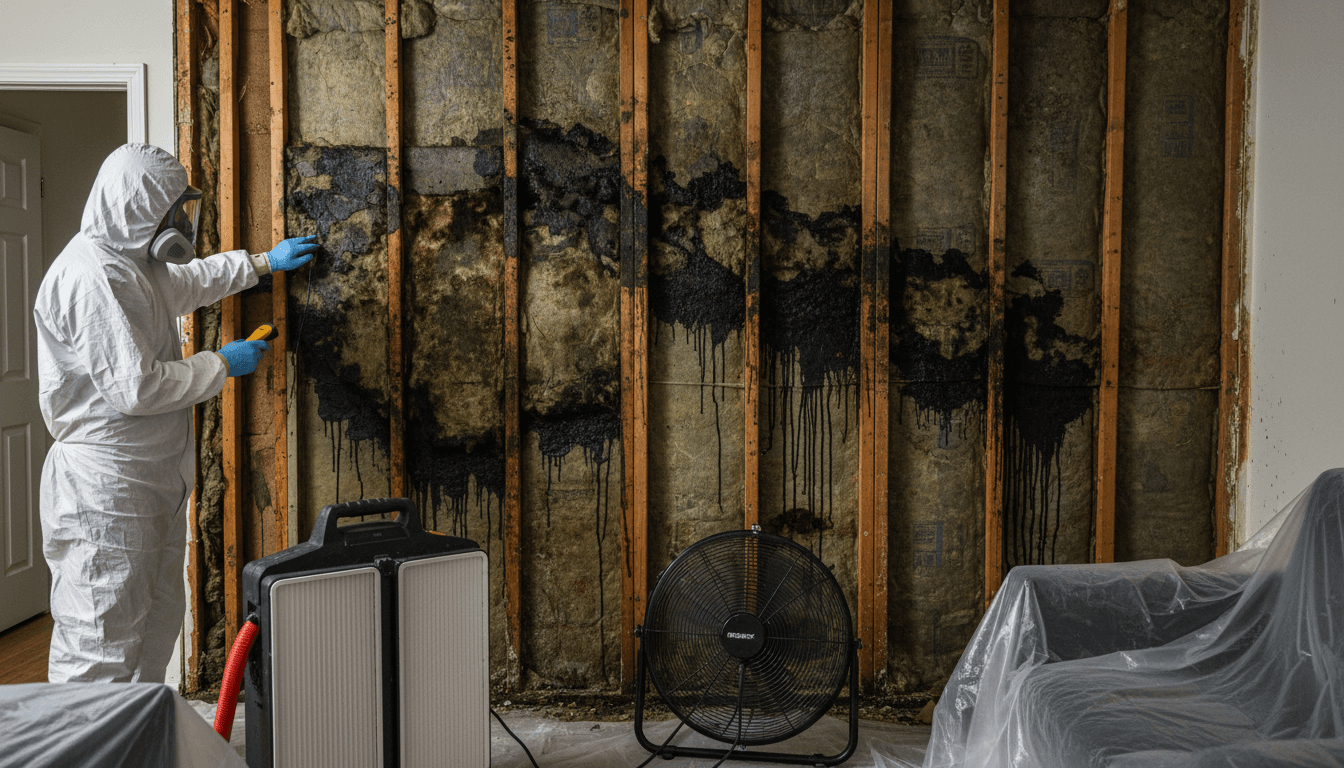
Mold remediation is not mold cleaning. Wiping visible mold off a surface with bleach or a consumer mold spray does nothing to address the colony's root structure (hyphae), which penetrates into porous materials like drywall and wood. It does not address airborne spores, which spread contamination to other areas of the home through normal air circulation. And it does not address the moisture source that allowed growth in the first place. Professional mold remediation is a contained, controlled process that removes contaminated materials, captures airborne spores with HEPA filtration, treats remaining surfaces with antimicrobial agents, and verifies through clearance testing that the space is safe for occupancy.
Our remediation crews hold IICRC AMRT (Applied Microbial Remediation Technician) certification, the industry standard for mold work. Every project begins with an inspection to determine the extent and location of mold growth. We use moisture meters, thermal cameras, and visual assessment to map affected areas — mold behind walls, under flooring, and in HVAC systems is common and often invisible from the living space. If laboratory testing is needed to identify the mold species or confirm the extent of contamination, we coordinate with accredited third-party testing labs. We do not perform our own testing for clearance purposes — that is an industry best practice to avoid conflicts of interest.
Once the scope is defined, containment goes up. Polyethylene sheeting isolates the affected area from the rest of the home, and HEPA-filtered negative air machines maintain inward airflow so spores cannot migrate out. Inside containment, all contaminated porous materials are removed — drywall, insulation, carpet, tack strip, and any wood that shows structural degradation from fungal activity. Non-porous surfaces and structurally sound wood are HEPA-vacuumed, wire-brushed or sanded as needed, and treated with antimicrobial agents. HEPA air scrubbers run continuously throughout the process to capture airborne spores.
After remediation is complete, containment stays up until third-party clearance testing confirms that spore counts in the remediated area are at or below normal background levels for the Nashville region. Clearance typically includes air sampling inside and outside the containment zone, surface sampling of treated areas, and a written report from the testing laboratory. Only after passing clearance is the containment removed and the space released for rebuild. We then address the original moisture source — whether that means coordinating plumbing repairs, HVAC upgrades, or drainage corrections — to prevent recurrence. Mold remediation without moisture correction is a temporary fix, and we do not do temporary.
What to expect
- 1
Inspection & Testing
Moisture meters and thermal cameras identify all areas of mold growth, including concealed growth behind walls and under floors. Third-party lab testing is coordinated when species identification or baseline spore counts are needed.
- 2
Containment Setup
Polyethylene sheeting isolates the work area from the rest of the home. HEPA-filtered negative air machines maintain inward airflow, preventing spore migration. All HVAC registers in the containment zone are sealed.
- 3
HEPA Air Filtration
HEPA air scrubbers run continuously inside containment from setup through clearance. These units capture airborne spores down to 0.3 microns at 99.97% efficiency, maintaining safe air quality for crews and preventing spread.
- 4
Mold Removal
All contaminated porous materials are removed and disposed of — drywall, insulation, carpet, and structurally compromised wood. Non-porous surfaces are HEPA-vacuumed and mechanically cleaned (wire brush or sanding) to remove surface mold.
- 5
Antimicrobial Application
Remaining structural surfaces receive antimicrobial treatment to eliminate residual mold and inhibit regrowth. Products are EPA-registered and rated for indoor use in occupied structures.
- 6
Clearance Testing
An accredited third-party lab performs air and surface sampling inside the containment zone. Clearance is achieved when spore counts are at or below normal background levels for the Nashville area. Containment is not removed until clearance passes.