
What we do
Nashville knows flooding. The May 2010 flood, the deadliest non-tropical inland flood event in the United States since 1994, dropped over thirteen inches of rain in two days, pushed the Cumberland River to 51.86 feet, and caused an estimated $2 billion in damage across Davidson County. But catastrophic events are not the only flood risk Nashville faces. Flash flooding after spring and summer storms regularly impacts neighborhoods along Mill Creek, Browns Creek, and Whites Creek. Low-lying areas in Bordeaux, Inglewood, Madison, and Old Hickory see water intrusion events every year that never make the news — yet leave homeowners facing the same damage, the same insurance headaches, and the same health risks as a headline flood.
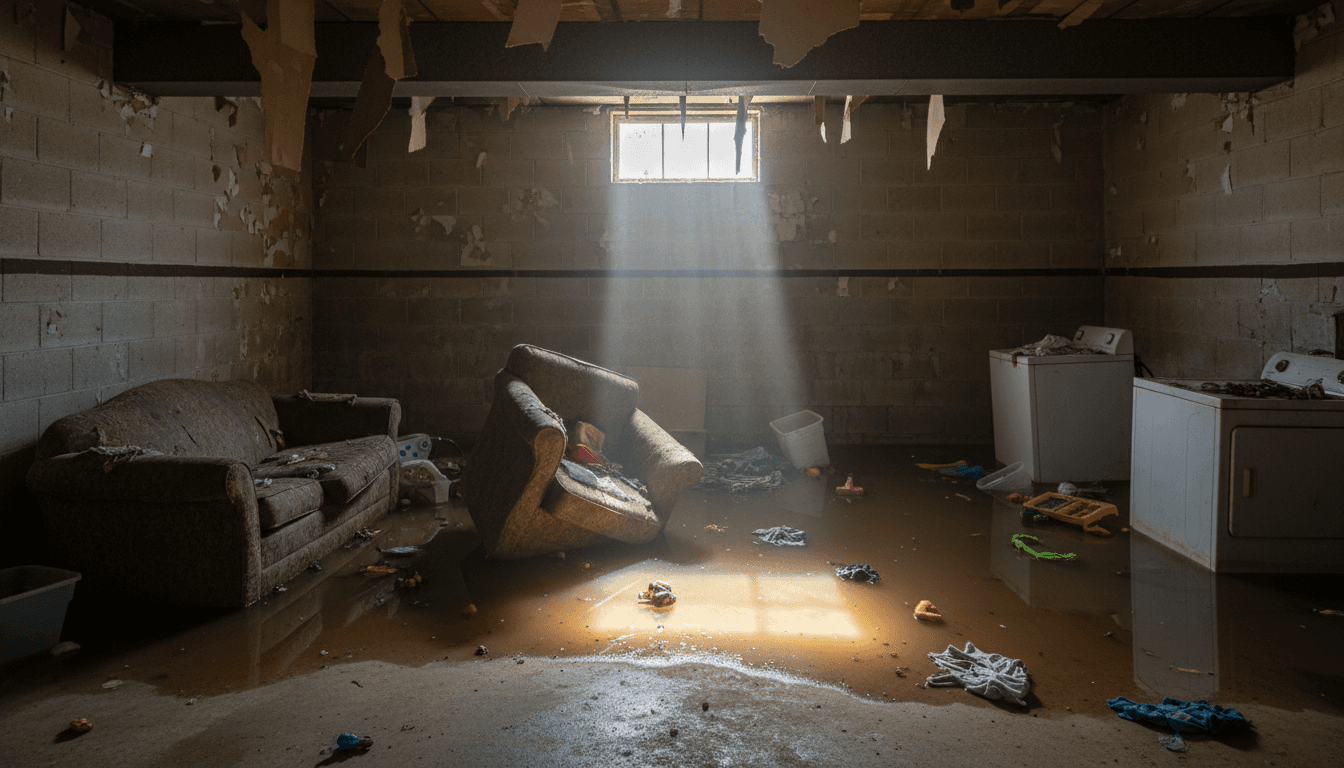
Flood damage restoration is a different discipline than standard water damage work. Floodwater is almost always Category 3 — the most contaminated classification — because it contacts soil, sewage, fuel, pesticides, and organic debris as it moves overland. Every surface floodwater touches must be treated as biologically contaminated. Drywall, insulation, carpet, carpet pad, particleboard shelving, and any porous material below the flood line is removed and disposed of. There is no drying and saving — it comes out. The remaining structure — studs, subfloor, concrete, brick — is cleaned, treated with antimicrobial agents, and dried to standard before any rebuild materials go in.
Our flood cleanup crews work in full personal protective equipment and follow a strict protocol designed around the IICRC S500 standard for water damage and the S520 standard for microbial contamination. The work proceeds in defined phases: emergency water extraction, selective demolition (also called tear-out or gut-out), structural cleaning and antimicrobial application, equipment-driven drying, clearance testing, and finally coordination with your rebuild contractor or our own reconstruction team. Each phase is documented with photos, moisture readings, and written scope notes for your insurance file.
For Nashville homeowners in FEMA-designated flood zones — and there are more of them than most people realize, stretching along the Cumberland, Mill Creek, Sevenmile Creek, and tributaries feeding into Percy Priest Lake — a separate National Flood Insurance Program (NFIP) policy is typically required. Standard homeowners insurance does not cover rising-water flood events. We help our clients understand the difference, document their damage in the format NFIP adjusters expect, and connect them with public adjusters when claims become complex. We have worked hundreds of flood claims in the Nashville metro area since 2010 and know the process inside out.
If your Nashville home has taken on floodwater, do not wade into the water unless you can confirm the electrical panel is off. Do not run HVAC systems — they will spread contaminated air through the ductwork. Move to the second floor or leave the structure if water is still rising. Once the water recedes, call us at (931) 499-1177. Our flood crews are pre-staged during severe weather events and can deploy immediately to Antioch, Hermitage, Bellevue, or anywhere in the metro.
What to expect
- 1
Emergency Response
Crews are pre-staged during flood events for immediate deployment. We arrive with truck-mounted extraction equipment, PPE, and containment materials. Safety assessment comes first — we verify power is disconnected and the structure is safe to enter.
- 2
Water Extraction
High-volume pumps remove standing floodwater. Extraction continues into subfloor cavities, wall cavities, and any below-grade spaces. All extracted water is handled as Category 3 contaminated material.
- 3
Demolition of Damaged Materials
Drywall is cut 12-24 inches above the visible flood line. Insulation, carpet, pad, baseboards, and all porous materials below the waterline are removed and disposed of properly. The remaining structure is exposed for cleaning and drying.
- 4
Drying & Dehumidification
Commercial air movers and dehumidifiers are placed throughout the structure. Drying times for flood-damaged structures are longer than standard water damage — typically 5-7 days — because wall cavities, subfloors, and concrete slabs hold moisture that must be drawn out completely.
- 5
Sanitization
All remaining structural surfaces receive antimicrobial treatment. Air quality is addressed with HEPA filtration. The structure is cleared for reconstruction only after moisture readings and visual inspection confirm it is clean and dry.
- 6
Reconstruction Coordination
We either rebuild in-house or coordinate with your preferred contractor. New drywall, insulation, flooring, baseboards, and paint are installed. The goal is to return the home to pre-loss condition — and we document every step for your insurance file.