
What we do
Standing water inside a home or business is a race against the clock. Every hour that water sits on your floors, it migrates deeper into subfloors, wall cavities, and structural framing. Within the first four hours, hardwood planks begin to cup. By hour twelve, drywall wicks moisture high enough to compromise insulation. After twenty-four hours, microbial growth can begin in concealed spaces you cannot see or reach with a shop vac. Emergency water extraction is the single most time-critical service in the restoration industry — and in Nashville, where summer humidity regularly pushes past 80 percent, the margin for error is even thinner.
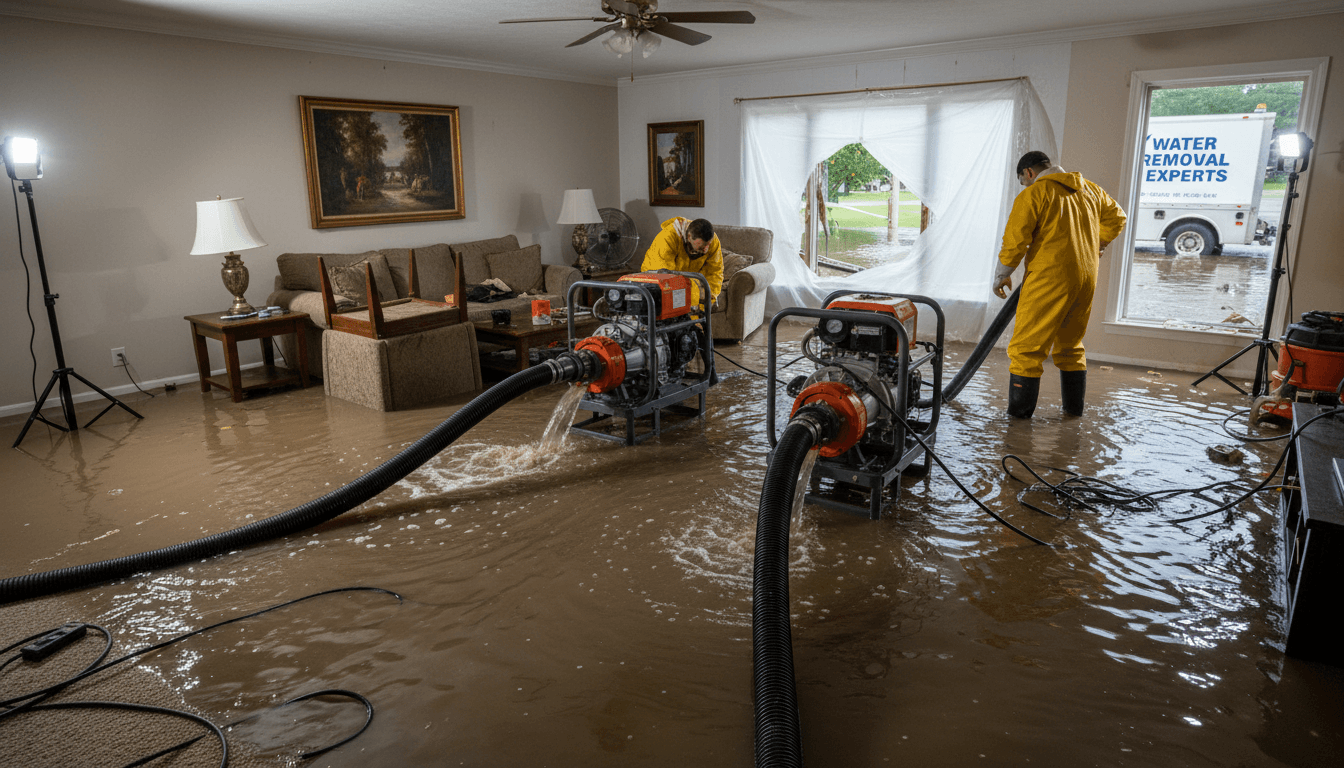
Our water extraction teams run truck-mounted pump systems capable of pulling thousands of gallons per hour. These are not portable units you can rent from a hardware store on Nolensville Pike — they are commercial systems powered by the vehicle engine, producing consistent vacuum pressure across long hose runs. Whether the water is pooled in a Donelson ranch-style basement or spread across three floors of an East Nashville Victorian, we size the equipment to the job and begin extraction the moment we arrive. Average response time across Davidson County is 45 minutes from the time you hang up the phone.
Once visible water is removed, the real work begins. Our technicians deploy infrared thermal cameras and pin-type moisture meters to map every wet surface — walls, ceilings, subfloors, and cavities behind cabinets. This moisture map determines how many commercial air movers and dehumidifiers we place and where they go. A typical single-story Nashville home with a burst supply line might require eight to twelve air movers, two commercial dehumidifiers, and three to five days of monitored drying. We check moisture readings daily, adjust equipment placement as the structure dries, and document every reading for your insurance claim file.
We handle water from every source: supply-line failures, appliance malfunctions (dishwashers, washing machines, water heaters), toilet overflows, roof leaks after a spring thunderstorm, and rising groundwater in low-lying neighborhoods like Bordeaux and Whites Creek. For Category 1 clean-water events, extraction and drying are typically all that is needed. Category 2 and Category 3 events — gray water from appliance drain lines or black water from sewage backups — require additional antimicrobial treatment and selective demolition, which our crews are trained and certified to perform on the same visit.
If you discover standing water in your Nashville home, shut off the water supply if you can safely reach the valve, move electronics and valuables above the waterline, and call us at (931) 499-1177. Do not attempt to remove water with a household vacuum — the electrical risk is real and the suction is insufficient. Do not wait until morning. Water damage compounds hourly, and the cost difference between a four-hour response and a twenty-four-hour response can be thousands of dollars in additional materials and labor.
What to expect
- 1
Emergency Assessment
A crew arrives within 45 minutes, identifies the water source, and categorizes the damage (Category 1, 2, or 3). We shut off the source if still active and brief you on scope before any equipment comes off the truck.
- 2
Water Removal
Truck-mounted pumps and weighted extraction tools pull standing water from carpets, hard floors, and subfloor cavities. High-volume extraction runs until no free-standing water remains anywhere in the structure.
- 3
Moisture Mapping
Using infrared cameras and pin-type meters, we document every wet surface and cavity. The resulting moisture map guides equipment placement and serves as the baseline for daily progress readings.
- 4
Equipment Placement
Commercial air movers and refrigerant dehumidifiers are positioned according to the moisture map. Equipment count is calculated to IICRC S500 drying-ratio standards for your structure's square footage and materials.
- 5
Daily Monitoring
A technician returns every 24 hours to take moisture readings, adjust equipment, and document drying progress. Readings are logged for your insurance file. Most structures reach dry standard in 3-5 days.